A few years ago I spent a year in Japan and lived in a student dorm. Like any student residence, most of us were foreign: Russians, Malaysians, Americans, Canadians, a couple of Germans and lots of Koreans. A busy little international community.
One of the Canadians had a great idea: an international hot-pot. Once a week, everyone cooked a traditional dish from home and brought it to one room, and we all shared what was on offer.
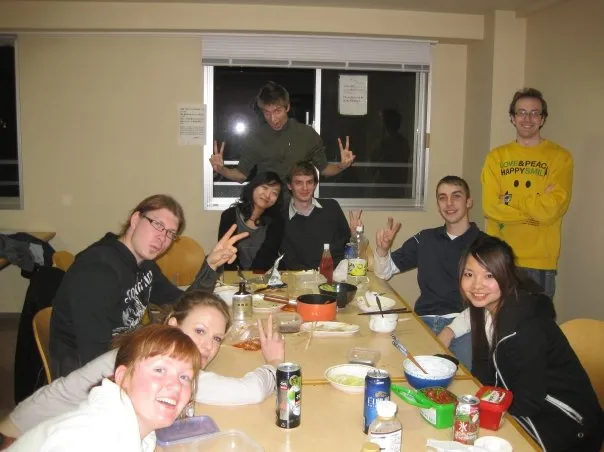
Apart from the food, think about what that did for everyone’s languages. Once a week, people learned about other cultures in a setting where learning was easy. One of the Americans picked up his first words of Korean and went on an exchange to Korea not long after getting back from Japan. I got a little of my French back (I can order a sandwich in Paris now), and most of the non-native English speakers improved fast.
It’s a good way in for anyone who wants to set up face-to-face language meetups. The atmosphere is friendly, and because everyone brings a dish, conversation comes easily. “What’s that? Borscht? How do you make it? It’s delicious.” Just make sure people cook different things. Nobody wants an international hot-pot with seven identical dishes.
Cooking together is even more fun, and there’s a meal at the end. You learn the kitchen vocabulary, and it’s always interesting to see how people from other places cook and season their food. Knowing the basics comes in handy the next time you’re invited to eat at someone’s place or cook with them.
In Japan I spent a lot of time with the French students, and once a Japanese family invited us over to cook something European. We made crêpes, which everyone loved. We didn’t know much kitchen vocabulary, but we got by.
Those evenings always left us feeling we’d learned quite a bit. There’s always an expression, an idiom or a phrase you take home and end up using everywhere. And without the pressure of a classroom, you can just play around with the language.